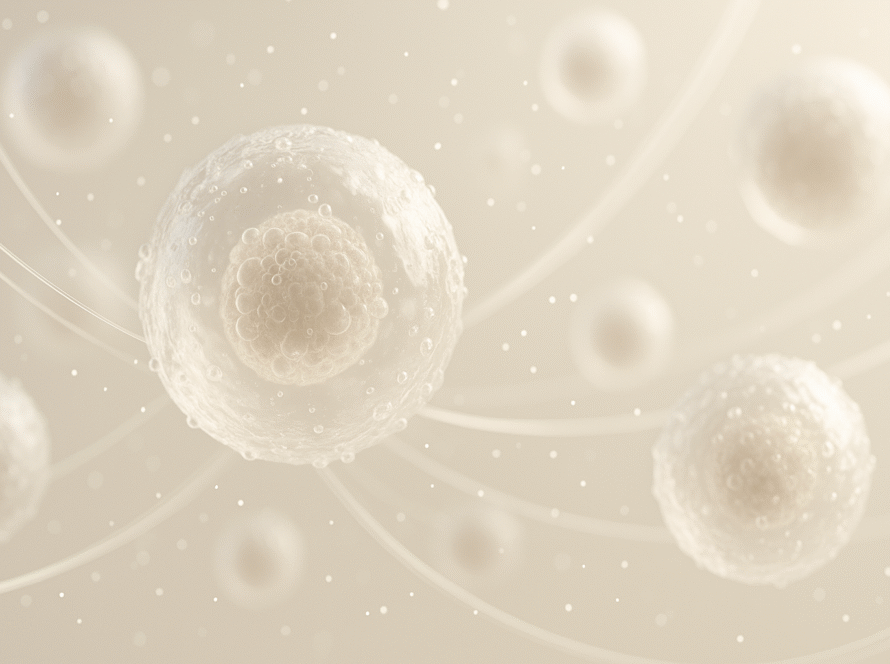
Skin aging is often described in terms of visible changes such as wrinkles, loss of elasticity, and uneven texture. However, these surface-level signs originate from deeper biological processes. At the center of this process are fibroblasts, the primary cells responsible for maintaining skin structure and function.
Understanding fibroblasts skin aging provides a more accurate framework for clinicians and aesthetic professionals. Rather than focusing only on surface correction, it shifts attention toward how skin behaves at the cellular level over time.
The Function of Dermal Fibroblasts in Skin Health
Dermal fibroblasts are specialized cells located within the dermis. Their primary role is to produce and maintain the structural components of the skin, including collagen, elastin, and other proteins that form the extracellular matrix.
The dermal fibroblasts function extends beyond simple structural support. These cells actively regulate the skin’s internal environment by:
- Synthesizing collagen and elastin fibers
- Producing growth factors and cytokines
- Supporting tissue repair and regeneration
- Maintaining overall dermal homeostasis
Through these activities, fibroblasts help preserve skin density, elasticity, and resilience. Their function is therefore closely tied to long-term skin quality, not just short-term appearance.


The Extracellular Matrix Skin: Structure and Stability
The extracellular matrix, often referred to as the ECM, is the structural framework that surrounds and supports skin cells. It is composed of collagen fibers, elastin networks, glycoproteins, and other bioactive components.
In healthy skin, the extracellular matrix skin provides:
- Structural support that keeps skin firm and dense, maintaining its overall shape and resistance to deformation
- Elastic recoil that allows skin to stretch and return smoothly, supporting flexibility and movement without lasting damage
- A functional environment where cells can communicate and repair effectively, enabling continuous renewal and balanced skin behavior
Fibroblasts are the primary architects of this matrix. They continuously produce and remodel ECM components to maintain balance within the dermis.
When fibroblast activity is optimal, the ECM remains organized and functional. When fibroblast activity declines, the ECM becomes fragmented and less efficient, leading to visible changes in skin structure.
Fibroblast Aging and Its Impact on Skin Structure
Over time, fibroblasts undergo functional decline. This process, known as fibroblast aging, typically begins as early as the late 20s to early 30s, when cellular activity gradually becomes less efficient. It affects both the quantity and quality of the signals these cells produce.
Key changes associated with fibroblast aging include:
- Slower collagen and elastin production, leading to thinner dermal structure and reduced skin firmness
- Weakened response to repair signals, meaning the skin recovers more slowly from environmental stress and procedures
- Increased breakdown of existing matrix proteins, accelerating the loss of structural integrity over time
- Less coordinated cellular communication, resulting in imbalanced regeneration and reduced overall skin efficiency
As fibroblast activity decreases, the extracellular matrix is no longer maintained effectively. This leads to a gradual loss of dermal density, reduced elasticity, and impaired structural support.
From a clinical perspective, this explains why aging is not simply a loss of volume, but a decline in the skin’s ability to maintain and repair its own structure.
Fibroblast activity is directly linked to the integrity of the dermal matrix. As activity declines, structural proteins are no longer produced at the same rate, contributing to visible changes in skin quality.
Cellular Communication: The Hidden Driver of Skin Aging
Beyond structural production, fibroblasts play a critical role in cellular communication. They interact with surrounding cells through signaling molecules such as growth factors, cytokines, and extracellular vesicles.
This communication network regulates:
- Tissue repair processes
- Inflammatory responses
- Cellular turnover and renewal
- ECM remodeling
With aging, this communication becomes less efficient. Fibroblasts produce fewer signaling molecules, and their ability to respond to environmental stimuli declines.
This disruption has a compounding effect. Reduced signaling leads to less coordinated repair, slower regeneration, and a gradual imbalance in the skin’s microenvironment.
Emerging research highlights that improving cellular communication may be as important as restoring structural components. Skin function depends not only on what cells produce, but also on how effectively they interact.
Advanced cell culture technologies have shown that when fibroblasts are placed in more physiologically relevant environments, such as 3D structures, their communication and secretion activity can increase significantly, producing a broader range of bioactive factors.


Clinical Implications: Moving from Correction to Functional Support
For clinicians and med spa owners, understanding fibroblast biology changes how treatments are evaluated and selected.
Instead of focusing solely on visible correction, there is a growing shift toward supporting the underlying mechanisms that drive skin behavior over time. This includes:
- Maintaining fibroblast activity
- Supporting extracellular matrix integrity
- Enhancing cellular communication pathways
This approach aligns with a broader movement in regenerative aesthetics, where long-term skin function is prioritized over short-term visual outcomes.
Clinically, this translates into more structured, preventive strategies that aim to preserve skin quality before significant decline occurs, while also supporting restoration when needed.
Conclusion: A Cellular Perspective on Skin Aging
Fibroblasts are central to understanding how and why skin ages. Their role extends far beyond collagen production, influencing the structure, communication, and regenerative capacity of the skin.
By focusing on fibroblasts skin aging, clinicians can better interpret the underlying causes of visible changes and adopt approaches that support long-term skin health.
The extracellular matrix, cellular signaling, and fibroblast function are interconnected systems. When these systems are supported, skin maintains its structure and resilience more effectively over time.
This perspective represents a shift from treating aging as a surface-level concern to understanding it as a process rooted in cellular function and biological performance.